

Most businesses are using AI. Few can prove what people are doing with it.
AI adoption is now visible across regulated SaaS businesses, but the evidence behind it is often much harder to see. People are using AI to move faster, yet leaders still need to understand where it creates value, where it introduces risk, and what to stop, fix or scale.

The agent's first day
65% of organisations have already had a cybersecurity incident caused by an AI agent. 60% of those couldn't stop it when it happened. Most businesses are deploying agents. Very few have built the infrastructure for agents to work as accountable team members, with the task systems, the collaboration layer, and the quality gate that sits between agent output and production. The gap between teams that handed agents tools and teams that built agents a team is already visible, and it is widening.

Who pushed that?
Code authored by AI now makes up 27% of all production code, and that number is rising fast. The question engineering leaders and boards need to answer is not how much of the codebase was written by AI. It is who committed it, with whose credentials, and whether there is a record of that decision that would survive an audit.

What trustworthy AI brands look like when design signals control
As scrutiny of AI companies grows, every design choice is being interpreted as a trust signal. But trustworthy AI brands aren't defined by typography or visual trends. They're defined by coherence. The businesses building credibility are the ones whose design, messaging and behaviour consistently demonstrate control, competence and clarity.

Buyers are judging your AI credibility before they speak to you.
Buyers in regulated markets are forming a view of your AI credibility before they speak to you. That view is being shaped by AI search tools you have no presence in.
The brands winning in this environment are not producing more content. They are building the capability that makes authority real.

The AI is invisible. The interface isn't.
AI does extraordinary things. But a buyer doesn't experience the processing power or the logic running underneath. They experience a screen, a document, a dashboard. Whether they understand the value on offer depends almost entirely on how well it's been communicated to them. This piece looks at why visual design is one of the most underused tools for building buyer confidence in AI products, and why the human in the loop still needs to like what they're looking at.

Regulated SaaS businesses have 62 days before the EU AI Act comes into force
2 August 2026 is no longer distant. With 78% of AI users bringing their own tools to work and 46% of AI proof-of-concepts scrapped before production, regulated SaaS leaders face a growing clarity problem. The issue is whether they can prove where AI creates value and risk.

Your AI offer sounds impressive. It just doesn’t sound commercially credible.
In regulated markets, a buying decision is not made by one person, it’s made by a committee that includes commercial, legal, compliance, finance, and operations.
Each of them is asking a different version of the same question: why should we trust this, and what happens to us if it goes wrong?

Show your working
88% of AI agent pilots never reach production. Most stall at the demo, not because the technology failed, but because nobody built the infrastructure to show what the agent actually did. In regulated software delivery, the question is no longer whether AI can build fast. It is whether you can prove every step.

Diagnose
Get immediate clarity on AI risk and stalled value creation
Our continuous, evidence-based scorecard shows where AI is exposing your organisation to risk, why value is falling short, and what to stop, fix, or scale.
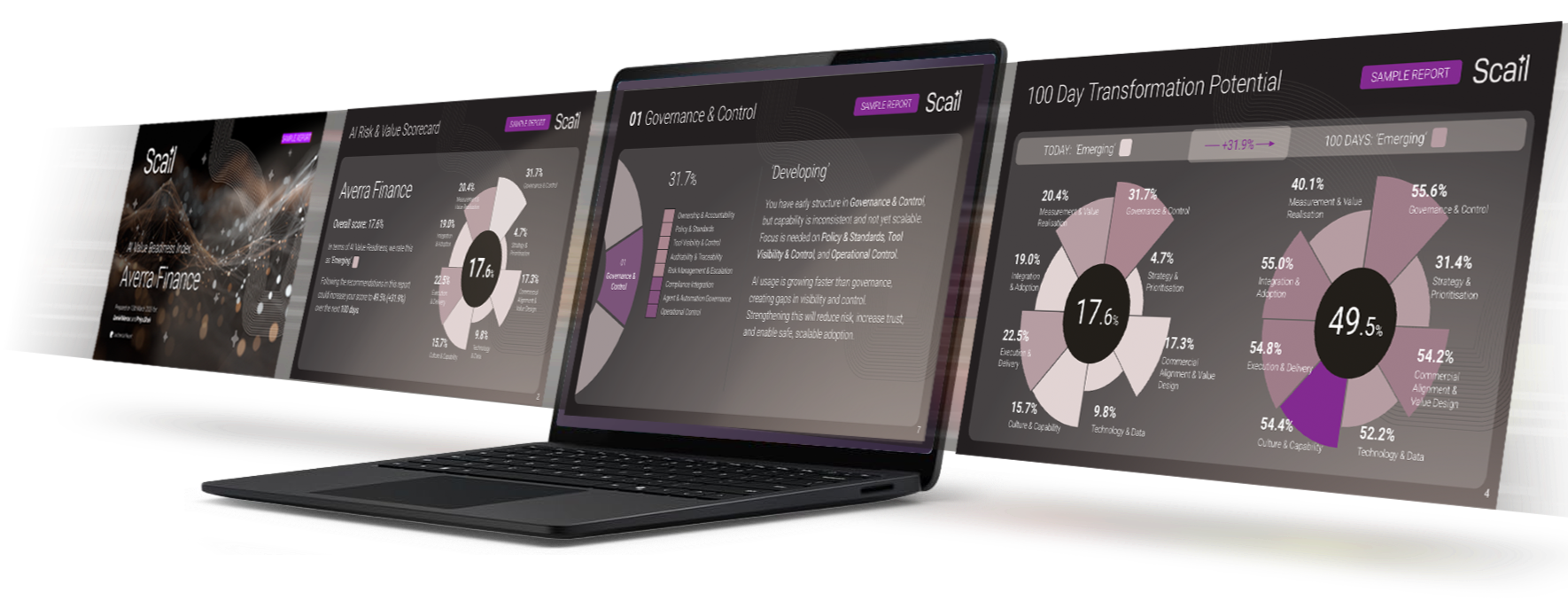
Screenshots from the 25-page personalised report we create as part of the AI Risk & Value Scorecard.

Research Report
The urgent challenges facing regulated SaaS as AI scrutiny grows
Regulated SaaS must build AI that proves value, reduces risk, strengthens control, and earns trust across products, teams, and governance.