

The tokenmaxxing trap
Enterprise AI bills are rising faster than most teams can explain, and the people spending the money are not always sure why. Token consumption now sits inside development costs, delivery timelines, governance decisions, and the CFO's spreadsheet, often all at once. The question is no longer "Are we using AI?" It is "Do we have any idea what it is actually costing us?

When the pace picks up, the brand is the first thing to go
AI tools have changed the pace of content production for almost every team. More output, moving faster, with less time for a designer to review it before it goes out. This piece looks at why a brand system matters more than ever when the volume picks up, what happens when it's missing at scale, and what we're learning at Scail from putting our brand guidelines directly into our AI tools.

Your brand has a voice. Does your AI know what it sounds like?
In regulated markets, where trust is the product and every communication signals how the business thinks, inconsistent brand voice is not a marketing inconvenience. It is a commercial risk.

Why AI products still need to be ‘designed’ for the people using them
Most AI products today are pretty good at the clever part and pretty hopeless at the human part. A designer's view on why user trust in AI systems gets earned in the small moments, not at launch.

What vibe coding broke that nobody is talking about
Vibe coding is moving through organisations faster than most teams can see, manage, or control. It now touches product output, brand presence, client tools, internal software, and every document that carries the company name. The question is no longer "Can we build faster?" It is "Does any of this look like it came from the same company?"

The shift you can feel but cannot measure
The early energy was good. Pilots ran. "Look what it can do" moments filled the channels. Now the board wants outcomes. Customers want value in their workflows. The CFO wants ROI.
Privately, you're wondering whether your team has actually moved past playing around. Microsoft's 2026 Work Trend Index puts numbers on the gap: only 19% of workers sit in the Frontier zone, and two-thirds of AI's impact comes from organisational factors, not individual mindset.
The shift from experimenting to relying is wider than most leaders think. Here's how to prepare teams for it.

A technology story doesn’t seal the deal. A value story can. And most regulated SaaS businesses have not built one.
Why AI pilots stall in regulated SaaS when the market story is weaker than the technology story.

The missing link in AI value creation
AI value stalls when too many ideas run without commercial prioritisation. The strongest returns come from focusing AI on meaningful business outcomes, not scattered experiments. For regulated SaaS leaders, AI ROI measurement is now the discipline that decides what to scale, what to fix, and what to stop.

Why AI safety needs to be seen, not just stated
Every week brings another headline about AI going wrong somewhere, another set of internal questions about whether the company can really say its AI is under control.

Diagnose
Get immediate clarity on AI risk and stalled value creation
Our continuous, evidence-based scorecard shows where AI is exposing your organisation to risk, why value is falling short, and what to stop, fix, or scale.
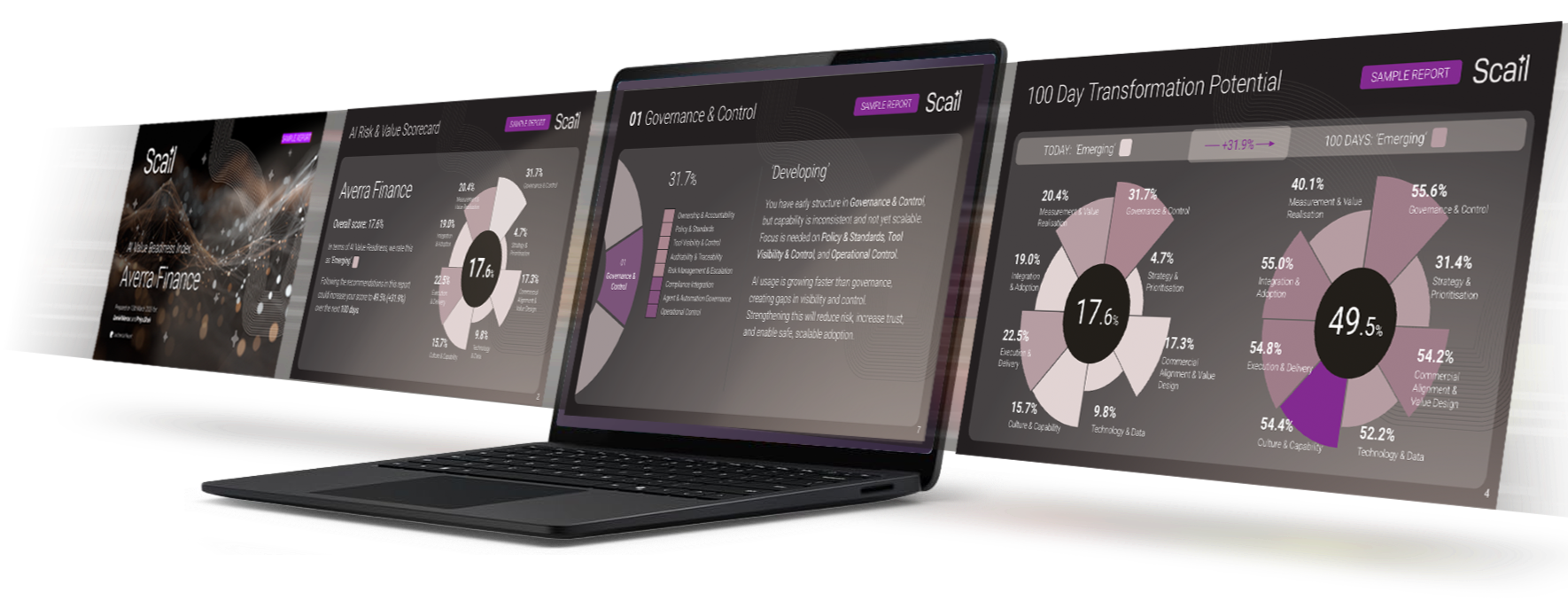
Screenshots from the 25-page personalised report we create as part of the AI Risk & Value Scorecard.

Research Report
The urgent challenges facing regulated SaaS as AI scrutiny grows
Regulated SaaS must build AI that proves value, reduces risk, strengthens control, and earns trust across products, teams, and governance.