
Why AI strategy needs optimism, but must be built on evidence
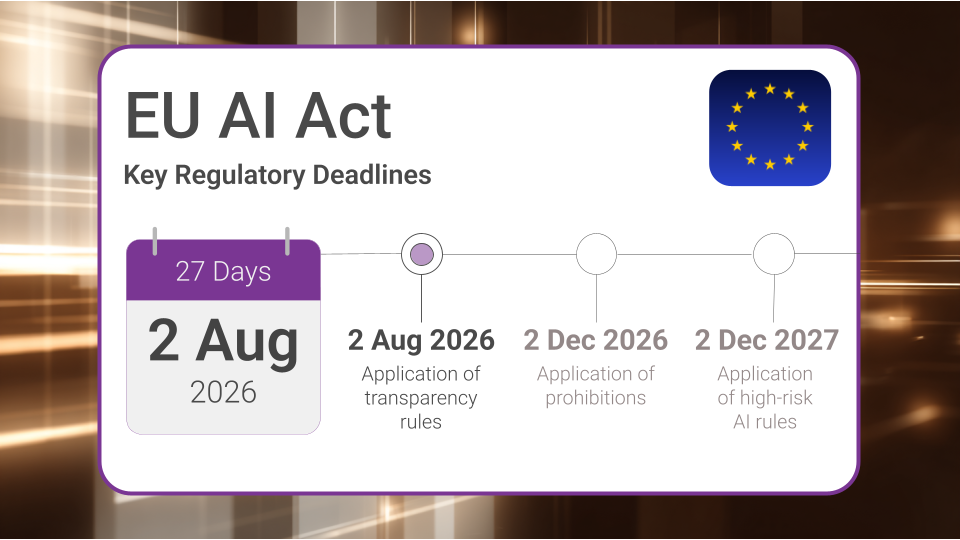
In 27 days, the EU AI Act becomes fully applicable, with phased exceptions. For regulated SaaS businesses, that changes the AI strategy conversation.
This is no longer only about innovation, experimentation or competitive advantage. It is about evidence, accountability and control.
Optimism still matters.
It gives teams permission to experiment. It helps leaders move through uncertainty. It creates the momentum needed to change how work gets done.
But optimism is no longer enough.
AI strategy for SaaS now needs to be grounded in evidence.
The August 2nd deadline changes things
Until now, many businesses have treated AI as a fast-moving layer of experimentation.
Teams have tried new tools. Leaders have encouraged curiosity. Workflows have been accelerated.
That early optimism has been useful.
But the arrival of the EU AI Act means leadership teams need to move beyond belief, intention and informal confidence.
The question is no longer simply, “What could AI do for us?”
It is:
Where is AI already being used?
What risks does that create?
Who owns the outcomes?
What controls are in place?
What evidence can we produce?
For regulated SaaS businesses, this matters more than most. These companies operate in environments where trust, security and compliance are part of the product experience.
Customers don’t just want AI-enabled features. They want confidence that AI is being used safely, responsibly and with proper oversight.
Evidence turns activity into strategy
The issue is not whether people are using AI. In most businesses, they already are.
The harder question is whether leaders can see which AI activities are creating value, which increase risk, and which ones should be stopped, fixed or scaled.
McKinsey reports that almost 90% of companies are experimenting with AI, but only 7% are scaling it enterprise-wide. Harvard Business Review found that only 16% of organisations report a high degree of measurable value from AI.
That gap is the problem.
Without evidence, AI strategy becomes a collection of opinions.
One team says a tool is saving time. Another believes a workflow is improving quality. Leaders hear that people are moving faster.
All of that may be true.
But unless those claims are measured against baselines, success metrics and business outcomes, they remain difficult to trust at the leadership level.
AI value measurement cannot be added later. It needs to be designed into the strategy from the beginning.
Compliance needs proof, not promises
The EU AI Act doesn’t mean that all AI initiatives should become slow, cautious or compliance-led.
But it does mean informal AI confidence is no longer enough.
If AI is shaping outputs, workflows, and customer experiences, leaders need a clearer view of what is governed, what is measured, and what remains unclear.
This is where evidence becomes critical.
Not because evidence kills ambition.
Because evidence protects it.
The best AI strategies hold optimism and evidence together.
Optimism creates the ambition to move. Evidence creates the discipline to move well.
That is why Scail created the AI Risk & Value Scorecard.
The Scorecard gives regulated SaaS leaders a practical way to understand where AI is already creating value, where risk is increasing, and where leadership action is needed next.
With 27 days until 2 August, evidence is no longer something to gather later.
It is the foundation for the next phase of AI strategy.
Read more about the AI Risk & Value Scorecard.
